


01
Scattered Borrower Data
ARC, passport, NIK, employer data, emergency contacts, and bank accounts need to be in one consistent record.
A custom platform for managing the NTD-denominated loan lifecycle for Indonesian migrant workers in Taiwan. The system connects borrower onboarding, contracts, installment payments, delinquency status, sales network commissions, and reporting for operations teams in Taiwan and Indonesia.

KSP Finance runs a personal loan business for Indonesian migrant workers employed in Taiwan. Loans are issued and repaid in NTD, while operations involve admin teams in Taiwan and Indonesia plus a tiered sales network of agencies, sales agents, and resellers.
When borrower data, contracts, payments, commissions, and delinquency status are managed manually, teams in two countries struggle to work from the same information. Scattered processes also make portfolio monitoring and payment follow-up more complex.
ARC, passport, NIK, employer data, emergency contacts, and bank accounts need to be in one consistent record.
Days overdue, grace period, penalties, and escalation thresholds require consistent calculations for each contract.
Agencies, sales agents, and resellers have different commission attributions that need to be calculated from loan disbursements.
Teams in Taiwan and Indonesia need the same view of payments, contract balances, delinquency trends, and reports.
Solunesia built a centralized platform to bring the entire loan lifecycle into one workflow. Borrower data starts from onboarding, flows to contracts and collection, then is used for loan status, commissions, and reporting without moving data between spreadsheets.
Borrowers, identity documents, contracts, payments, penalties, sales network, and status history are connected in one operational record. Access rights and interface language are adapted so teams in Taiwan and Indonesia can work on the same system.
ARC can be read with AI to help populate identity, dates, and employer information.
Loan amount, installments, remaining balance, status, and days overdue can be monitored from one page.
Payments are recorded against penalties and principal according to the active contract conditions.
Sales network attribution and management reports use transactions already recorded in the system.
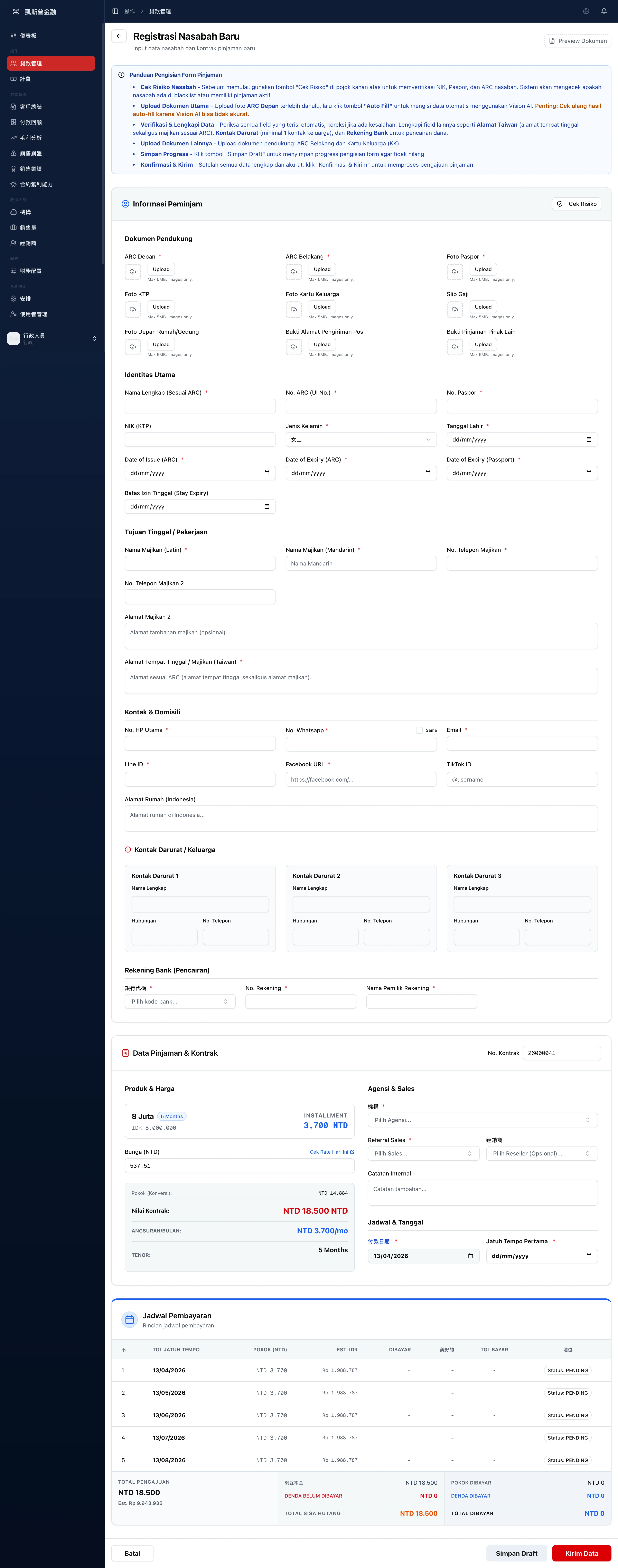
The registration form is designed to reduce repeated input at the initial stage. ARC documents can be used to help populate data, then the system runs identity checks and loan history checks before the process continues.
ARC photos are processed to extract identity data, important dates, and employer names into the form.
NIK, passport, and ARC can be checked against blacklist and active loan history before onboarding proceeds.
Identity, employment, contacts, bank accounts, and initial contract information collected in one input flow.
Operations teams need a quick view to see who the borrower is, what contracts are active, loan amounts, payment status, and delinquency levels without opening multiple separate files.
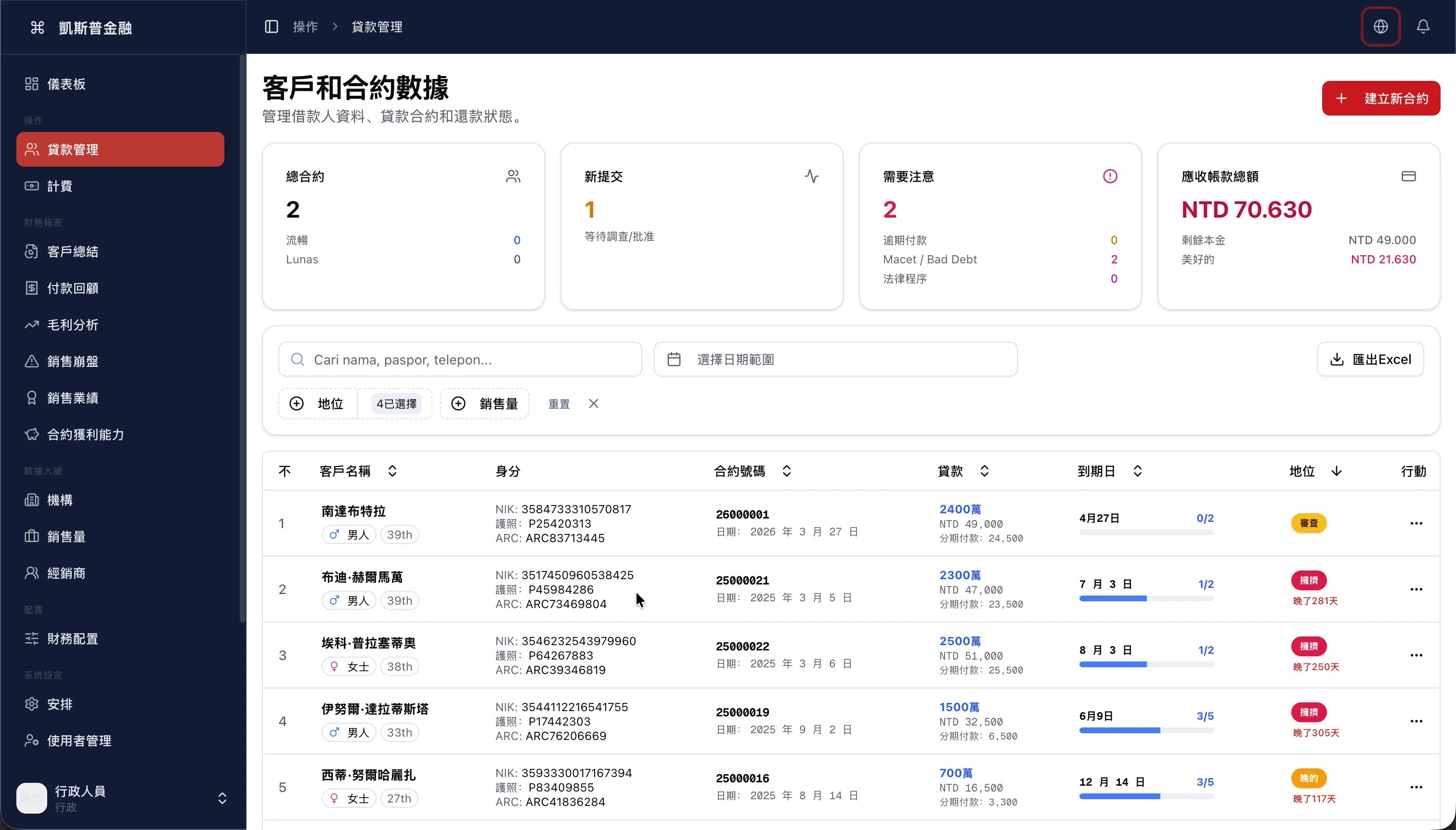
The contract list shows the borrower's key identity, contract number, loan amount in NTD, location, associated sales agent, and status indicators such as settled or overdue with day count.
Recording payments is not just about reducing the balance. The system needs to understand remaining principal, running penalties, contract status, and payment allocation order so collection stays consistent across the entire team.
Enter the payment amount received.
The system reads fines and current contract conditions.
Payment is directed to penalties or principal per the rules.
Remaining NTD and contract status are updated in the same record.
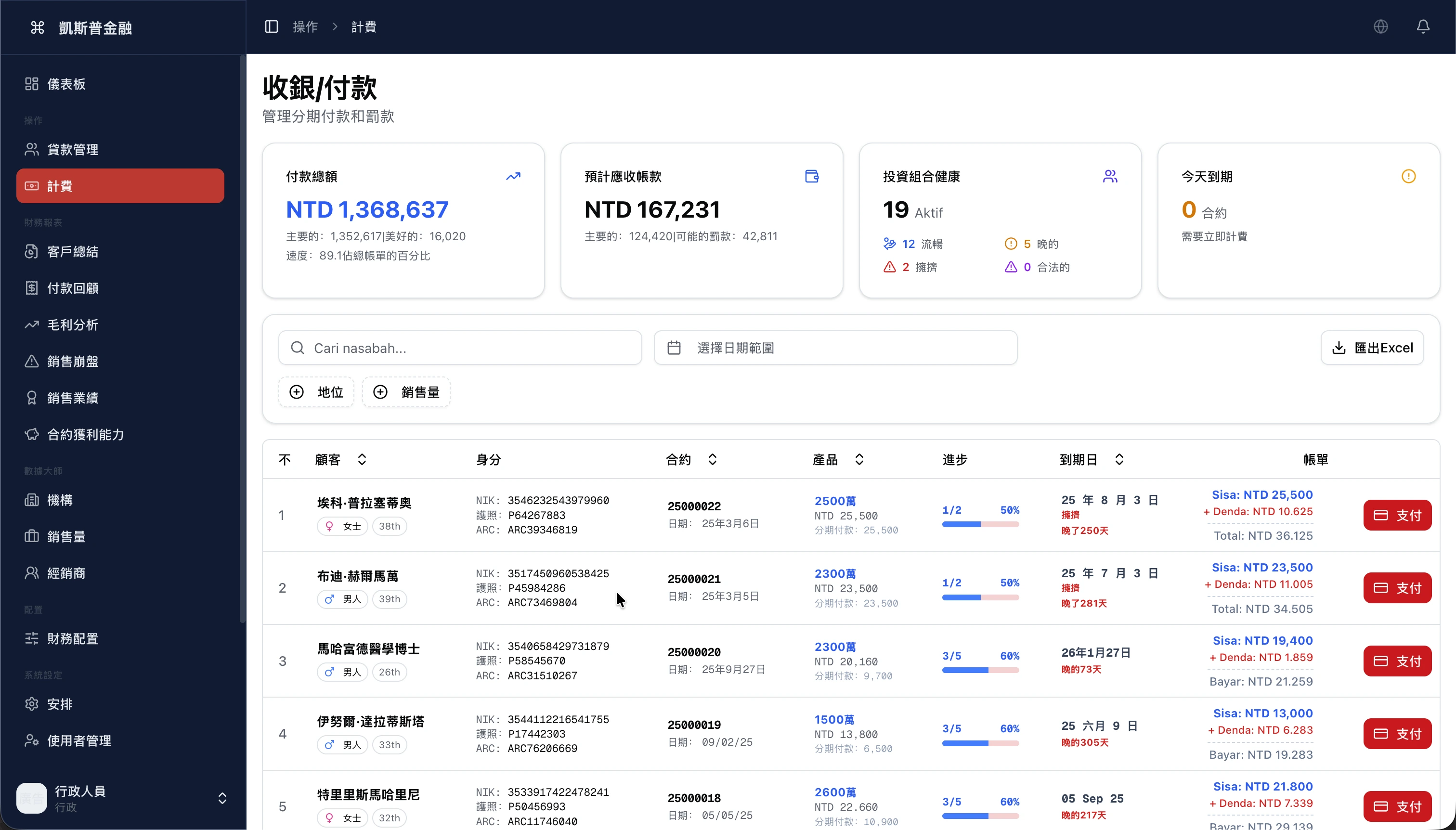
The management dashboard summarizes portfolio conditions from recorded contract and payment data. Teams in Taiwan and Indonesia can view the same information through role-based, bilingual interfaces.
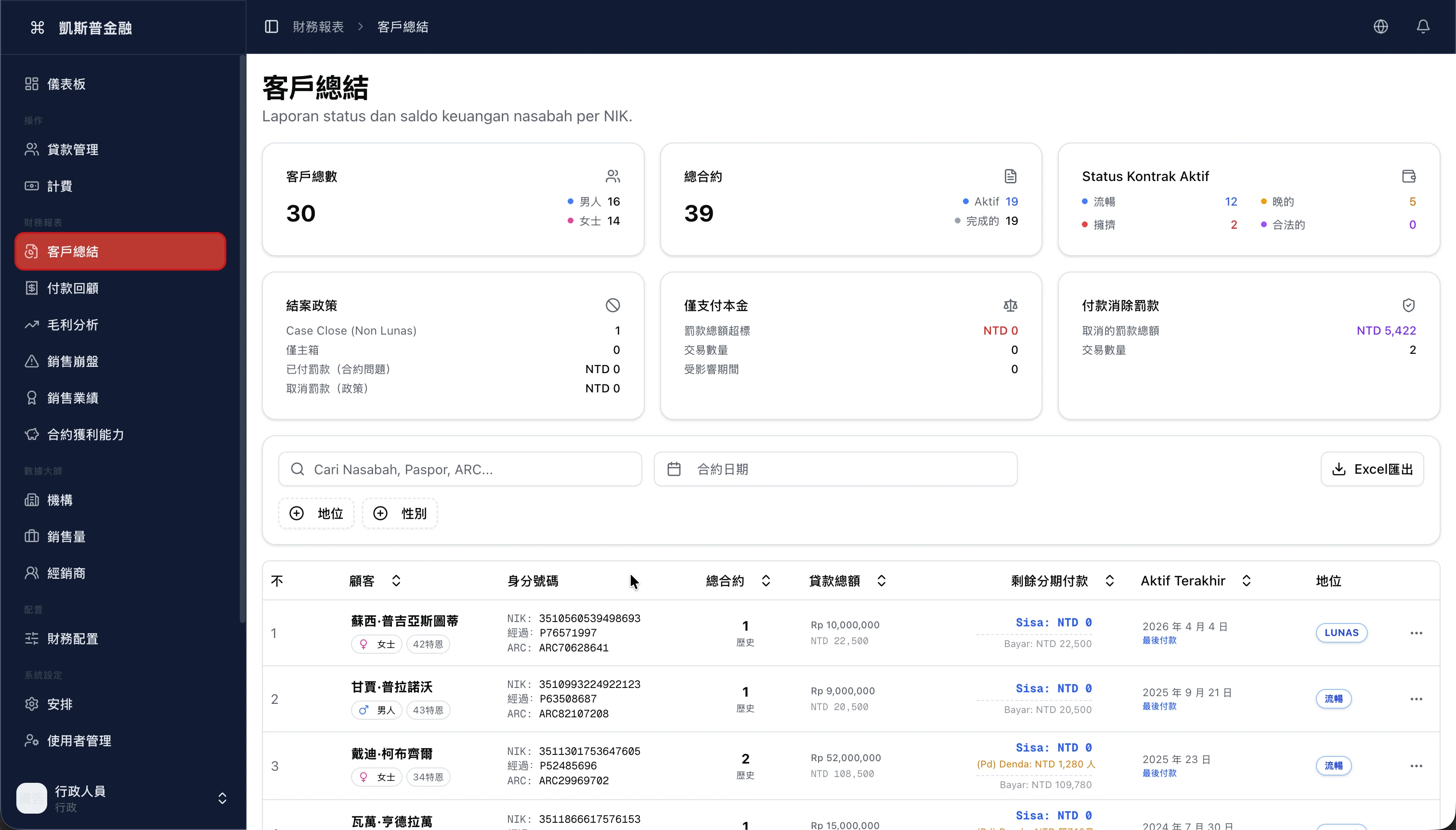
Management summaries can show the number of borrowers, active and completed contracts, outstanding balances, and portfolio conditions. The system also supports financial reporting from payment recaps through to per-contract analysis.
Implementation moved previously scattered processes into one digital flow. Teams can work from the same contract data, while payment status, delinquency, commissions, and reports follow recorded transactions.
Onboarding, contracts, collection, status, and settlement can be traced in one system.
Overdue days and status changes can be monitored based on rules applied in the system.
Agency, sales agent, and reseller attribution follows recorded contracts and disbursements.
Teams in Taiwan and Indonesia access the same data with appropriate access rights and language.
Start with onboarding, contracts, collection, commissions, and reporting still managed through many tools.
We help identify the data, workflows, access rights, and business rules that need to be connected in one platform.
Once the process is clear, modules, integrations, automation, and implementation phases can be structured more effectively.